FOTOGRAFIE VOOR BEGINNERS
“Eindelijk begrijpen wat je camera doet.”
2 uur · Schoorlse Duinen · €39,00 p.p. · max. 10 deelnemers
Fotografie workshop voor beginners in Schoorl
Je hebt een mooie camera. Misschien zelfs al een tijdje.
Maar eerlijk?
Je fotografeert nog vaak op de automatische stand. Niet omdat daar iets mis mee is, maar omdat termen als diafragma, sluitertijd en ISO al snel ingewikkelder klinken dan ze hoeven te zijn. En al die knopjes op je camera?
Je weet ongeveer wat sommige doen. Maar waarom je de ene keer een onscherpe foto krijgt, waarom de achtergrond soms mooi vervaagt en soms niet, of waarom je foto ineens veel te donker wordt? Dat blijft soms gokken.
Daar is deze fotografie workshop voor beginners voor.
In twee praktische uren leer je de belangrijkste instellingen van je digitale camera begrijpen én gebruiken.
Geen ingewikkelde technische les. Geen uren theorie.
We gaan fotograferen.
2 uur · €39,00 p.p. · Schoorlse Duinen · maximaal 10 deelnemers
Fotografie workshop voor beginners in Schoorl
2 uur fotografie · €39,95 p.p. | maximaal 10 deelnemers | camera of smartphone
Welke datum past jou?
Zaterdag 10 oktober
10:00 - 12:00
Locatie Schoorlse Duinen
min 4 personen / max 8 personen
Nog 4 plekken vrij
Dinsdag 13 oktober
10:00 - 12:00
Locatie Schoorlse Duinen
min 4 personen / max 8 personen
Nog 6 plekken vrij
zaterdag 17 oktober
13:00 - 15:00
Locatie Schoorlse Duinen
min 4 personen / max 8 personen
Nog 6 plekken vrij
Dinsdag 6 oktober
18:00 - 20:00
Locatie Schoorlse Duinen
min 4 personen / max 8 personen
Nog 3 plekken vrij
Van automatische stand naar bewust fotograferen
De automatische stand is helemaal niet verkeerd.
Maar als je meer uit je camera wilt halen, helpt het enorm wanneer je begrijpt waarom je camera bepaalde keuzes maakt.
Tijdens deze basiscursus fotografie leer je stap voor stap hoe de belangrijkste instellingen met elkaar samenwerken.
We behandelen onder andere:
diafragma
sluitertijd
ISO
scherpstellen
scherptediepte
belichting
de belangrijkste standen van je camera
wanneer je welke instelling gebruikt
Je hoeft na twee uur echt niet iedere knop van je camera uit je hoofd te kennen.
Dat is ook helemaal niet het doel.
Het doel is dat je naar huis gaat en denkt:
Aha. Nú begrijp ik wat mijn camera doet.
Wil je na deze basiscursus verder dan de techniek?
Tijdens de Photography Experience Schoorlse Duinen draait het juist om compositie, licht, storytelling en anders leren kijken.
Eerst begrijpen wat je camera doet. Daarna ontdekken wat jíj ermee kunt zien.
Fotografie leren door het meteen te doen
Je kunt twintig artikelen lezen over de belichtingsdriehoek.
Maar fotografie leer je uiteindelijk door te fotograferen.
Daarom vindt deze fotografie workshop voor beginners plaats in de Schoorlse Duinen in Noord-Holland, vlak bij Alkmaar.
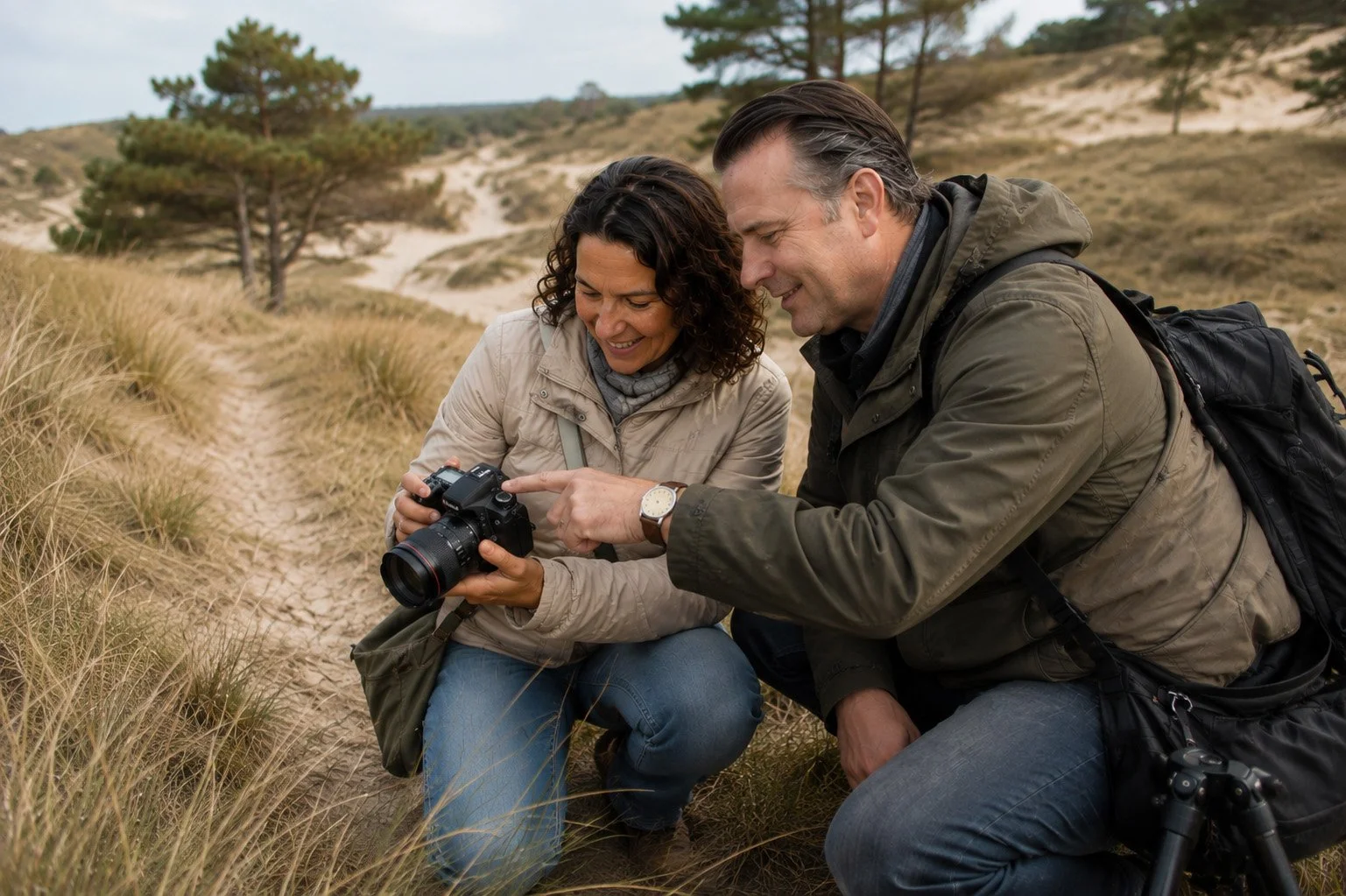
We gebruiken de omgeving als ons klaslokaal.
Ik leg iets uit.
Jij stelt je camera in.
Je maakt de foto.
We bekijken wat er gebeurt.
En daarna veranderen we bijvoorbeeld het diafragma of de sluitertijd en maak je dezelfde foto opnieuw.
Het verschil zie je onmiddellijk.
Zo worden ISO, sluitertijd en diafragma geen abstracte begrippen meer, maar gereedschappen waarmee jij bepaalt hoe jouw foto eruitziet.
Wat leer je tijdens deze beginnersworkshop fotografie?
Diafragma
Wat betekent bijvoorbeeld f/2.8 of f/11?
Je ontdekt hoe het diafragma invloed heeft op de hoeveelheid licht én op de scherptediepte in je foto.
Waarom is bij het ene portret de achtergrond prachtig onscherp, terwijl bij een landschap juist veel scherp mag zijn?
Sluitertijd
Waarom wordt beweging soms onscherp?
En hoe kun je beweging juist bewust bevriezen?
Je leert wat sluitertijd doet en wanneer je een korte of langere sluitertijd kiest.
ISO
Wanneer verhoog je de ISO?
Wat gebeurt er met je foto als je dat doet?
En waarom wil je ISO meestal niet zomaar zo hoog mogelijk zetten?
Scherpstellen
Je leert hoe je bewuster bepaalt waar je camera scherpstelt, zodat niet je camera maar jij bepaalt wat belangrijk is in het beeld.
De belichtingsdriehoek
Diafragma, sluitertijd en ISO staan niet los van elkaar.
Samen bepalen ze de belichting van je foto.
Ik leg de belichtingsdriehoek uit in gewone taal en vooral aan de hand van wat je direct op je eigen camera en foto's ziet.
Voor wie is deze fotografie workshop voor beginners?
Deze workshop is gemaakt voor beginnende fotografen met een digitale camera.
Bijvoorbeeld wanneer je:
net een spiegelreflexcamera of systeemcamera hebt gekocht;
je camera al langer hebt maar vooral automatisch fotografeert;
diafragma, sluitertijd en ISO eindelijk wilt begrijpen;
wilt leren hoe je jouw camera zelf instelt;
mooiere en bewustere foto's wilt maken;
geen zin hebt in een lange technische fotografiecursus en al helemaal niet uit een boekje;
vooral wilt leren door zelf te fotograferen.
Je hebt geen voorkennis nodig.
En je hoeft absoluut niet van de automatische stand af omdat dat zogenaamd “hoort”.
Ik wil dat je begrijpt welke mogelijkheden je camera je geeft.
Daarna bepaal jij zelf wanneer je die gebruikt.
Fotografie cursus voor beginners in Noord-Holland
BAKKM Photography geeft deze praktische fotografie workshop in de Schoorlse Duinen, goed bereikbaar vanuit Alkmaar en andere plaatsen in Noord-Holland.
De combinatie van bos, duinen, hoogteverschillen, zandpaden, licht en verschillende onderwerpen maakt Schoorl een prachtige plek om de basis van fotografie direct in praktijk te brengen.
Je zit dus niet twee uur in een leslokaal naar een presentatie te kijken.
Je camera gaat mee naar buiten.
We wandelen, oefenen, vergelijken foto's en kijken samen wat verschillende instellingen met een beeld doen.
Kleine groep, veel persoonlijke aandacht
De bediening van een Nikon werkt anders dan die van een Canon, Sony, Fujifilm of ander cameramerk.
En iedere deelnemer begint ergens anders.
Daarom werk ik bewust met een kleine groep max 10 personen.
Er is ruimte om vragen te stellen en om even met je mee te kijken wanneer je een instelling niet kunt vinden of niet begrijpt wat er gebeurt.
Het gaat niet om wie de mooiste of duurste camera heeft.
Het gaat erom dat jij jouw eigen camera beter leert begrijpen.
Wat neem je mee?
Neem mee:
je digitale camera;
een opgeladen accu;
een lege geheugenkaart;
de lens die je normaal het meest gebruikt;
eventueel een extra accu;
goede wandel- of sportschoenen;
kleding passend bij het weer;
bij kans op regen: bescherming voor jezelf én je camera.
Een statief is voor deze fotografie workshop voor beginners niet nodig.
Heb je de handleiding van je camera op je telefoon? Neem die dan mee. De bediening en menu's verschillen per cameramerk en model, dus soms is dat handig tijdens de workshop.
Verder heb je niets bijzonders nodig. We gaan vooral fotograferen.
Van je camera begrijpen naar anders leren kijken
Van je camera begrijpen naar anders leren kijken
Na deze workshop weet je beter hoe je camera werkt.
Maar techniek is uiteindelijk alleen gereedschap.
Een sterke foto ontstaat niet alleen door de juiste ISO, sluitertijd of het juiste diafragma.
Daar begint voor mij het interessantste gedeelte van fotografie:
anders kijken.
Waarom blijft de ene foto hangen en loop je aan de andere voorbij?
Wat doet licht?
Waar plaats je je onderwerp?
Wat laat je bewust buiten beeld?
En hoe vertel je met één foto een verhaal?
Dat is waar we tijdens de BAKKM Photography Experience – Anders Kijken mee aan de slag gaan.
Drie uur lang veel minder over knopjes en veel meer over licht, compositie, aandacht en storytelling.
Speciaal voor deelnemers aan deze beginnersworkshop
De Photography Experience kost normaal €89 p.p.
Na deze beginnersworkshop ontvang je €20 korting wanneer je binnen 30 dagen de Photography Experience boekt.
Zo kun je eerst je camera leren begrijpen en daarna de volgende stap zetten:
van techniek naar fotografie.
Wat kost de fotografie workshop voor beginners?
€39 per persoon
Daarvoor krijg je:
2 uur praktische begeleiding;
uitleg over je eigen camera;
diafragma, sluitertijd en ISO;
scherpstellen en belichting;
praktische foto-opdrachten;
fotograferen in de Schoorlse Duinen.
Geen technisch examen.
Gewoon twee uur waarin je eindelijk leert begrijpen wat er gebeurt wanneer je op die ontspanknop drukt.
Wie geeft de workshop?
Ik ben Marcel Bakker, fotograaf en oprichter van BAKKM Photography.
Voor mij gaat fotografie uiteindelijk niet over zoveel mogelijk technische kennis verzamelen.
Techniek moet je helpen om het beeld te maken dat jij voor je ziet.
Daarom leg ik de basis begrijpelijk en praktisch uit. Geen wedstrijd in vaktermen, maar kijken wat een instelling daadwerkelijk met jouw foto doet.
Mijn eigen fotografie draait om licht, compositie, storytelling en anders kijken.
En precies daar wil ik je uiteindelijk naartoe brengen.
Eerst begrijpen wat je camera doet.
Daarna ontdekken wat jij ermee wilt vertellen.
Veelgestelde vragen
Is deze fotografie workshop echt geschikt voor beginners?
Ja. De workshop is speciaal bedoeld voor beginnende fotografen. Je hebt geen voorkennis nodig. Ook wanneer je voornamelijk op de automatische stand fotografeert, kun je gewoon deelnemen.
Welke camera heb ik nodig?
Je hebt een digitale camera nodig waarop je zelf instellingen zoals diafragma, sluitertijd en ISO kunt aanpassen. Dat kan bijvoorbeeld een spiegelreflexcamera of systeemcamera van Nikon, Canon, Sony, Fujifilm, Panasonic of een ander merk zijn.
Moet ik al in de M-stand kunnen fotograferen?
Nee. Juist niet. Tijdens de workshop leer je hoe de belangrijkste instellingen werken en hoe ze elkaar beïnvloeden. Het doel is begrijpen wat je doet, niet zo snel mogelijk alles handmatig instellen.
Leer ik de belichtingsdriehoek?
Ja. We behandelen diafragma, sluitertijd en ISO en vooral de samenhang tussen deze drie. Je past de uitleg meteen toe met je eigen camera.
Waar wordt de fotografie workshop gegeven?
De workshop vindt plaats in de Schoorlse Duinen in Noord-Holland, vlak bij Alkmaar. Voor iedere workshop ontvang je vooraf praktische informatie over het exacte ontmoetingspunt.
Hoe lang duurt de workshop?
De fotografie workshop voor beginners duurt ongeveer 2 uur.
Wat kost de workshop?
De prijs is €39 per persoon.
Hoe groot is de groep?
Ik werk bewust met kleine groepen zodat er voldoende ruimte is voor vragen en persoonlijke begeleiding.
Is dit hetzelfde als de BAKKM Photography Experience?
Nee. De beginnersworkshop draait vooral om het begrijpen van je camera en de basis van fotografie. Tijdens de Photography Experience gaan we juist verder met anders kijken, licht, compositie en storytelling.
Kan ik daarna verder leren?
Ja. De logische vervolgstap is de 3 uur durende BAKKM Photography Experience in de Schoorlse Duinen. Als deelnemer aan de beginnersworkshop ontvang je €20 korting wanneer je deze binnen 30 dagen boekt.
Klaar om eindelijk te begrijpen wat je camera doet?
Je hoeft geen betere camera te kopen.
Je hoeft ook niet eerst honderd YouTube-video's te bekijken.
Neem gewoon de camera mee die je hebt.
Na twee uur begrijp je beter wat diafragma, sluitertijd en ISO doen, weet je waar een aantal belangrijke instellingen voor dienen en kun je bewustere keuzes maken wanneer je fotografeert.
Fotografie workshop voor beginners
Schoorlse Duinen · Noord-Holland
2 uur · €39 p.p. · kleine groep